
2026 Voters Support Child Care for All
Leading into the 2026 election, voters support bold solutions to address the child care affordability crisis. Large majorities of likely voters support universal child care and want to see thriving wages for the child care workforce.
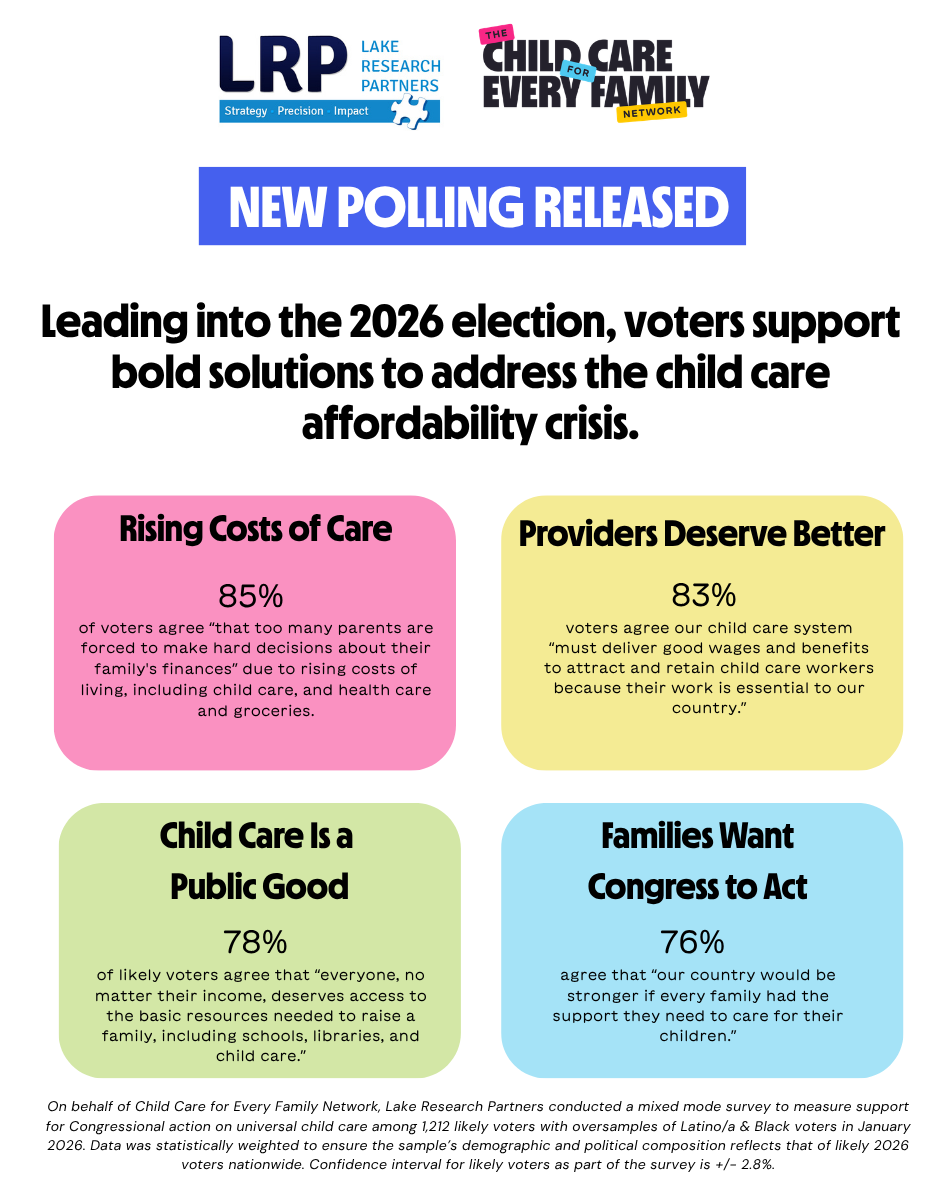
In 2026, voters see the affordability crisis and the child care crisis as one and the same:
- 85% of voters agree “that too many parents are forced to make hard decisions about their family’s finances” due to rising costs of living, including child care, and health care and groceries.
- 83% of voters agree “it shouldn’t be impossible for working people to afford to raise a family in America.”
Voters are fully aware that the system has failed the child care workforce, and strongly believe that a universal child care system must include better wages for providers.
- 83% of voters agree our child care system “must deliver good wages and benefits to attract and retain child care workers because their work is essential to our country.”
- Worker-centered messages resonate strongly with voters (74% found very convincing): “Parents trust early childhood educators with what matters most—their children—but too many of those workers are among the lowest paid workers in our country. Many skilled educators can earn more working retail than in classrooms shaping the future of our youth. The system has failed early child care educators and a universal child care plan must include good wages and benefits for educators. Their work is essential to families, the economy, and the future of our country.”
Voters see child care as a public good: a universal child care system has broad benefits, beyond just the additional support to families:
- 78% of likely voters agree that “everyone, no matter their income, deserves access to the basic resources needed to raise a family, including schools, libraries, and child care.”
- 77% of likely voters agree that “investing in child care is an investment in children’s long-term success.”
- 76% agree that “our country would be stronger if every family had the support they need to care for their children.”
When it comes to Congress taking action on universal child care, voters are paying attention to the details. About three-quarters of voters are more likely to support a universal child care bill that:
- “Provides good wages and benefits for all child care workers.” (78%)
- “Allows for flexible scheduling of child care for parents or guardians with unpredictable work schedules.” (76%)
- “If a parent or guardian loses or changes their job, their child does not lose child care.” (75%)
- “Is available to all families, including middle class families and families with lower incomes.” (75%)
- “Provides child care on nights and weekends for parents or guardians who work nights or weekends.” (73%)
Large majorities of likely voters believe the following outcomes are likely if Congress passes universal child care:
- Parents can stay in the workforce (79%)
- Parents are able to have a job (75%)
- Increase financial stability for families (71%)
 Spanish
  English